Charnes’s lucky dice
The Reincarnationist PapersCharnes’s lucky dice are a pair of small white dice whose material links them to the repeated bodily endings and returns that define the Cognomina’s members. Chance gives them to Evan as a welcome gift, promising luck; later, when Chance wants to borrow them for a card game, Evan refuses after Auda offers him money not to. The dice move from one member’s possession to another, but their value in the scene lies less in any demonstrated power than in the relationships and choices gathered around them.
Material and Origin
The dice are small and white, and Chance presents them as something more personal than an ordinary gaming accessory. He tells Evan, “I had them carved from the bones of my last body. I was very lucky back then. They should bring you luck too.” The explanation binds the object to a former life: its material is not merely associated with Chance’s past but, by his account, comes from the body he inhabited before this one. The dice thus carry a physical trace of the condition the group shares, even as Chance gives them a practical purpose in the present.
Chance’s claim that they bring luck belongs to the gift’s meaning, not to any proven supernatural effect. He insists on their value when Kress dismisses the offering as meager, answering, “Hey, no jest. Those things will really bring luck. I should know.” His confidence makes the dice a token of experience as well as a promise. Yet the account leaves their efficacy open: they are made from a former body and claimed to be lucky, but the events that follow show people negotiating over possession, not the dice producing a verifiable result.
A Welcome Gift
The dice enter the story during a ceremony in which the Cognomina welcome Evan as a new brother. Poppy explains that for centuries each member has offered a newcomer something special. When Chance’s turn comes, he stretches out an arm and drops the pair into Evan’s waiting hand. The compact gesture makes the transfer immediate: what Chance has kept as his own becomes Evan’s first by right of the group’s welcoming custom.
The other members respond differently to the gift. Kress questions whether it amounts to much, while Samas allows that Chance may have a point about its luck. Their reactions place the dice between modest appearance and asserted significance. They are neither presented as a costly possession nor dismissed by their giver as trivial. Chance’s insistence gives the small object a value shaped by his own history and by the ceremony’s expectation that a gift should be particular to the person offering it.
The welcome also takes place within a community that makes provision for members across lifetimes. Auda separately instructs that five thousand dollars be placed in escrow for Evan, unavailable until he returns in a new body, so that he will have something to come back to. The money and dice offer different kinds of reassurance: Auda’s gift is explicitly conditional on Evan’s return, while Chance offers an object associated with the body he has left behind and the luck he says accompanied him. Together, they make the welcome both intimate and practical without making the dice themselves a financial asset.
The Dice at the Card Table
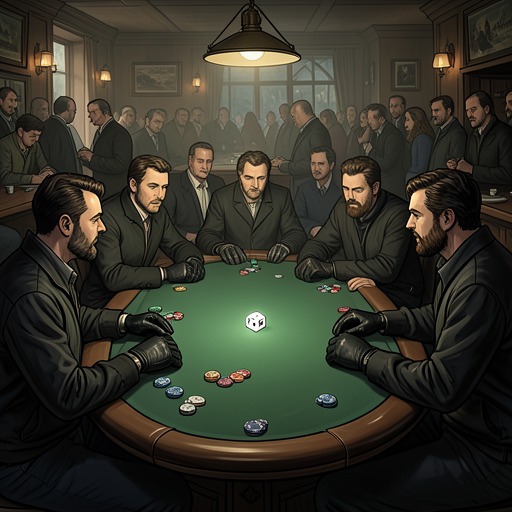
Later, the dice become the focus of a card-table exchange. Poppy suggests that Chance may be cheating, and Chance answers that nobody cheats better than he does. Auda then needles him about having given the lucky dice to Evan. The joke turns the ceremony’s transfer into a live test of ownership: Chance gave the object away, but he now wants it back temporarily, asking Evan for a loan of a few hours and offering one thousand dollars.
Evan reaches for his pocket and is about to agree. Before he can answer, Auda offers him two thousand dollars if he will not lend the dice. Chance’s request and Auda’s counteroffer make the gift negotiable again, putting its ceremonial meaning beside its possible use at the game and its immediate monetary leverage. Chance recognizes Auda’s intervention and sinks back into his seat; the exchange ends not with a return of the dice but with Evan choosing to keep them.
Auda tosses Evan an oversized gold coin. Evan looks across the table at Chance and says, “No dice,” then pockets the coin. The phrase refuses the requested loan while echoing the object at the center of the bargain. The members chuckle and continue dealing. The dice remain with Evan, while Chance’s earlier gift is reaffirmed through a choice made under pressure rather than through another formal gesture.
Significance
The dice’s changing role gives the welcome gift a small but distinct arc. First, Chance presents them as a personal object bearing the mark of his previous body and offers them as a promise of luck. Then, at the card table, their new owner must decide whether the gift can be briefly reclaimed for money. Evan’s refusal preserves the transfer, while the gold coin he accepts shows that keeping the dice does not require rejecting every material offer around them.
That contrast is central to the object’s place in the scene. The dice are not valuable because the narrative establishes a winning roll; their significance comes from their origin, their place in a centuries-old welcome, and the moment when Chance tries to borrow them back. Their path from Chance’s former body, through his hand, into Evan’s, gives a small object a role in making the Cognomina’s welcome tangible—and in showing that a gift can acquire social weight beyond its size or price.